
Interrupting Infinity Exclusive Commentary. © 2011 by David St.-Lascaux
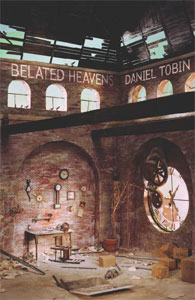 A CRITIC’S EDUCATION IN POETRY includes awakening to the counterintuitive proposition that a poet would contrive to construct a themed collection, or that poems might be scientifically planned. The reason the very idea of theme repels the uninitiated is because of its artificiality, and the assumption that poetry is inherently non-serially narrative (Homeric, Dantean and Miltonian epics, “Leaves of Grass,” and Omeros excepted).
Meanwhile, professionals take poetry for granted as a labored craft (if sometimes an inspired art), risking equation of practicing poetry to performing finger exercises on piano. It seems the norm today to find poetry collections divided up into thematic sections. (Indeed, the Poetry Foundation organizes poetry just so on its website, with its “Poetry Tool” bucketing poems by “Category” and “Occasion.”) There are two ways this can come about: a) naturally/accidentally – by accumulating poems and subsequently identifying themes through reverse engineering, or b) by intention. Either way, a convincing themed collection of poetry is hard to pull off, given the poetry reader’s expectation of unexpected novelties and desired discontinuity, and that poets who repeatedly versify on the same topic or with a single technique ultimately – good heavens! – bore.
Certainly, there are analogs to such suites in other arts – visual artists’ permutations (e.g., Alexander Calder’s mobiles) and composers’ aural signatures (e.g., Philip Glass’s synthesized ambient pulsations). The literary arts include Colette’s My Mother’s House, a collection of vignettes thematically chronicling her mother’s life. Still, the thematic poet must overcome a certain skepticism.
Subject matter aside, a book of 48 poems, four sets of twelve, defines at least formal intentionality. That these numbers should directly relate to the collection’s theme is something that ought to be expected from Belated Heavens, the new collection by the intellectual deep-sea diver Daniel Tobin. A book whose introduction quotes the obscure German mystic Jakob Böhme on the hackneyed “world of stars and four elements” (please, poets, enough of fire, air, water, earth – they’re so 17th Century) virtually promises to be divided into four elemental sections, but it’s not – the quartet following another, inscrutable logic. And, given the numerous embedded references to mystics and their poetry, one more than half expects Tobin’s original title, which appears in the knockout poem, “The Air Mattress,” to be source-cited in endnote exegesis.
First, to be clear: theme or no, Belated Heavens never bores. Most every poem in Belated Heavens is thoroughly thought out, tightly rendered, full of life and dense reflective matter. Tobin will undoubtedly appeal to kindred spirits: fellow openers of doors to eccentric obscurantisms, the kitchen-sink-curious cats. Tobin answers the question of whether a writer should make a reader work in the emphatic affirmative: most of the poems in Belated Heavens require the dictionary or – even better – the encyclopedia, wherein one finds “esurience” (hunger); a short list of psychopomps; Anatole Deibler – the meticulous, dynastic French executioner; Koko, the signing “Smart Animal Gorilla,” authoress “on air”; and other offbeat tidbits of language, culture and zoology. There’s humor, too: “Westwood,” the first poem, ends:
Now euphony wings through the barren halls.
Pick up the phone: Your beloved is calling.
The fatuous pomposity of “euphony wings” utterly disarmed by the juxtaposed hilarity of G*d, or belovèd, calling on the landline. And, in “An Orange Tree in the Redlands”:
… where I come from
only tennis shoes grow on trees,
and the first islander to see snow
ran to escape the volcano’s blast.
There are intentional, referential homages: “Intruders,” a tender recollection after Tobin’s mother’s death, darkly recalls Robert Burns’s beastie “To a Mouse,” Walt Whitman’s “Leaves of Grass,” Alan Dugan’s “Funeral Oration for a Mouse,” and, most closely, Rosanna Warren’s touching eulogy-monody to her father, “A Kosmos.” Coincidence, or comfort food for literati? What’s more important is the heartfelt poem, on its own merits, ending touchingly:
… like a spirit
come in stealth to whisper the momentous,
then, turning back, thought the better of it.
As implied above, Tobin’ homages are sometimes sourced. However, when a poet makes as many wide-ranging references as Tobin does (e.g., “À la recherché du ciel perdu,” a paraphrastic reference to Marcel Proust’s À la recherché du temps perdu), why not just footnote on the fly?
Especially powerful poems in Belated Heavens include “To Acedia” (spiritual torpor), in which Tobin-trademark phraseology and cerebration lilt:
If skin could think,
And it does, it would
and the titular “Heaven” (posted to Third Party Poetry), the centerpiece of Belated Heavens and the sizable grain of sand from which this collection probably grew:
Or let it be like that obscure couple
carved in relief on a cathedral wall,
among the line of souls the only two holding hands,
as though their mortal love persisted undiminished,
the Divine Life subsumed in their simple gesture,
and eternity were only a short walk together
to that still, small place where memory is healed.
Sharply seen and romantic, until the horrid, cribbed last line. Closing this flawless poem with a lifted allusion to Czeslaw Milosz, as an endnote informs, not only makes no sense, but abdicates the opportunity to close originally. On top of that, one feels sorry for Milosz, if that was his view of heaven, if it was his tragic conviction that his memories required healing. That life is what one makes it is well to be remembered. And I’m certain “that place” is neither still nor small. Memento vivere, I say; heaven can wait.
It is especially gratifying that Tobin has the courage and talent to so adeptly address political themes. “The Expedition,” on an ice-free pole; the closing of “Clear Cut,” quoting John Milton (unlike Milosz, here making perfect sense):
“The world was all before them, where to choose
Their place of rest, and Providence their guide:
They hand in hand, with wandering steps and slow,
Through Eden took their solitary way.”
– Paradise Lost
Who whacked them one by one?
Not us. The ant army
of the poor (who better
to blame)
…
Good thing we don’t live
here; good thing we only
buy the posh armoir[e]
…
Call it
Gouge Meadows. Scourge Acres.
And earth was all before them.
– “Clear Cut”
Belated Heavens’s standout among standouts, “An Icon from the Flood,” demonstrates Tobin’s ability to create poetry that arrests the soul, flows like floodwaters off the tongue, demanding thespian recitation (minus the gratuitous, uneuphonious “blood and shit,” which will surely be deled in future iteration). Its lines contain word strings that can be read staccato, disconnected:
Against North Sea surges steel walls drop
In “Icon,” Tobin utilizes the device Raymond Carver employed in “Cathedral,” Carver’s best short story, about Heaven, in which he repeats the key word – “sight” – to accumulating effect. So Tobin repeats “saved” three times (Peter’s frequency of denial) to damn us all to Hell:
I watch talking heads drone on about the saved,
hollow notes in an afterthought of wind
…
of a church become a house of the fallen,
or a fallen house fled by the desperate saved.
…
a man pleads from a world consumed by waves
to us, to each of us, with his arms lifted,
as though it were we who needed to be saved.
In a refreshingly unegotistical twist on poetry’s all too frequent, implicit solipsism, Belated Heavens includes the explicitly autobiographical “After The End,” in which a Dane-ish Daniel, which goyim are reminded means “G*d’s judge,” speculates upon the afterlife with humor and a trope “of things” – “a dance of things,” “the chance of things,” suddenly turning serious and profoundly poetic:
… His best self longed for God,
A home within the extravagance of things.
Does Tobin thoroughly cover this ultimately challenging material? Not really. Strangely, reflections on “eternity” and “infinity,” fascinations of the Hispanic heroes Jorge Luis Borges, Juan Ramón Jiménez, Lezama Lima, Pablo Neruda, et al., are minimally invoked, suggesting that Tobin hasn’t yet explored this exotic territory (although a single line of W.B. Yeats on the subject of the desirability of a verbatim do-over [“yes”] more than compensates for any such omissions, and Lori Nix’s relict Clock Tower cover photo has dystemporal appeal). Ironically, Tobin covers the physical more than the metaphysical, with not so much envisioned heaven as the volcanic upheavals of infernal earth, whereforth from “A Volcano”:
He watches from his perch the earth’s offing burn
Gold, black, and red. The world’s the burning stream.
Whether earthbound or heaven-peeping, Belated Heavens’s poems take the reader on a relentless journey in the company of a modern-day Dante Alighieri with a hyperinquisitive, lexigenial, associative mind. The flaws are few, and fixable: to dispense with the alchemical arcana; to banish the tedious similes “like” and “as”; to avoid unuseful repetition of certain favored words (e.g., “effulgence”); to temper stilted histrionics (e.g., “dark now as that incongruous slab” [“Foundation”]); to have the courage to fly solo sans homage. In the end, Tobin knows where it is: on the last page, 81, where it should be, at Sally’s mundane diner in “As Angels in Some Brighter Dreams” (its title from Henry Vaughan’s shimmering, opti-mystic “They Are All Gone into the World of Light”) where it’s never too late, and Tobin’s perdurable poetry basks in extravagant apotheosis.
* * *
Daniel Tobin’s Belated Heavens is available from Four Way Books.
* * *
