
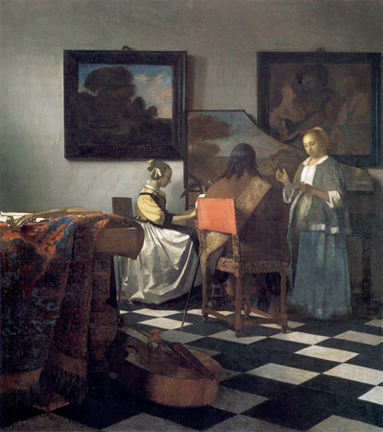
Johannes Vermeer, The Concert (c. 1664)
Read St.-L’s “Vermeer’s mistress” at this link.
Twenty Years Later
by David St.-Lascaux
March 18, 2010 is the twentieth anniversary (if you care to call it that) of the theft of Johannes Vermeer’s (1632-1675) The Concert from the Isabella Stewart Gardner Museum in Boston. So it was bittersweet to visit the Gardner on the 17th, a beautiful almost equinoctial day in the City of That Dirty Water, which the local radio station obligingly played as the ambulances’ EMTs attended to the usual alcohol-poisoned, emerald-green-clad, overindulgent acolytes of St. Patrick. (They say the Dutch, when their commercial empire collapsed, resorted to alcoholic escapes, but that’s coincidental.)
The Gardner deserves to be a World Heritage site, but isn’t yet. Adequately admiring encomia cannot be raised to this lenitive oasis of civilizations – Western, Mideastern, Eastern. Walk into the Yellow Room and there’s a sleeping, secret Whistler curled up in the corner – Nocturne, Blue and Silver: Battersea Reach (c. 1872-8), a harbor scene in gray oil and fog, Ryderesque, with orange dots of light reflected on the water. Enter the stone-floored Spanish Cloister adjacent to her Palace Courtyard (on the other side her Chinese Loggia and sideyard) and there at the end is Sargent’s El Jaleo: the Flamenco dancer with her come-with-me-to-life alive erotic limbic gestures, underlit as if for Mrs. G herself. The lush and verdant artificial glassrooved greenhouselike four-storey courtyard in which she saw her visitors; on its floor Medusa’s tiled central capit and the statuary turned to stone, her sly Gorgonic joke. Orchids everywhere, and flanking grey gravel, fronds, a fine fountain with dolphins in relief, and more flowers.
The Gardner is three floors of art and antiquary artifacts. Roman sarcophagi flank the ground floor Courtyard (a practical decision, given their weight), one of Dionysian revelers with bunches of grapes, remembering Gardner’s guests, perhaps, to live enough and die. The third floor with its Botticellis (who was said to have acquiesced to bibliopyre Savonarola’s demand that he destroy his “pagan” paintings as contribution to the zealot’s Falò delle vanità [“Bonfire of the Vanities”]). Pull aside a bookcase curtain down the Gallery and Dante’s original La Divina Commedia faces you behind the glass. On the second floor, pull aside a display case cloth, and Marie Antoinette’s signature is there – neat as you please (did she tap away, one asks, in a Gardner séance?). A concert room next (fond memories), then through the back halls lined with Japanese screens – of peonies and phœnices, inter alia. And then you’re in the fated room.
The Dutch Room. At the top of the Courtyard’s fountain’s twin stairlets, the two empty Rembrandt frames, and, at the end, since your memory remembers standing there as if it was yesterday, backed by a mirror, The Concert’s frame. What a feeling – to be in one’s twenties – an aspiring artist standing in front of another Vermeer – for the first time, your eyes a virgin’s, a doe’s, your cortex caressed, heavily petted, and you were reassured that everything would be alright, that life would be beautiful, that we domesticated gods, serene, will be safe as long as we aspire and create and love and hope and dream. That we’re safe in our beds at night.
And then they showed up, with duct tape and blades. The details don’t matter: The Concert is over. Which begs the question: Who would steal from humanity? I’m not talking about the flunky delivery boys – mere hired hands – but the commissioner of the crime. Imagine waking up every day, looking at The Concert, knowing that you’ve raped the world, knowing that you’re headed for Alighieri’s Ninth Circle, having betrayed yourself and your humanity, knowing that no human being – child or adult – has been transformed in twenty years, looking at this thing to swoon for, this secular shrine, this painted dream. Knowing that you’ve stolen twenty years from the human race. What joy would that bring? What pleasure? What meaning would it have, you having imprisoned it, solitarily confined it, taken it away from its beloved home, its admirers? Can’t he be a man, at last, and give it back?
It’s true that Mrs. Gardner was a materialist par excellence, but she valued her assembled art as inspirational, and established the museum, in her will’s words, “for the education and enjoyment of the public forever.” It’s also true that Vermeer painted for the fruits of economic opportunism, painted material comfort, caste and class, and even probably used a camera obscura. But g*d could he paint, in an era when artists aspired to infinity. Vermeer died at age 43 in 1675, having made 35+ paintings. The thief, too, will die soon – in the next 40 years, most certainly, assuming he was at least 40 in 1990. So what will happen? Will his family or friends, if any, come forth? Will we have to wait another twenty years to aspire again, to dream? Let’s hope not.
* * *
Information regarding the whereabouts or theft of the Gardner’s Vermeer may be provided to the Boston office of the FBI by calling (001) 617-742-5533. The FBI’s Theft Notices & Recoveries webpage describing the theft is at this link.
The Gardner is in the process of expanding with a design by architect Renzo Piano slated to open to the public in 2012. The space will include a greenhouse, performance hall, special exhibitions gallery, conservation labs and administrative offices. Information can be found at this link.
* * *
